

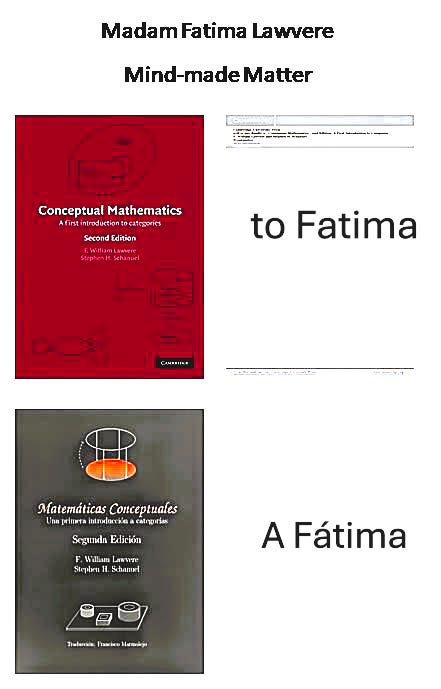
Madam Fatima Fenaroli Lawvere, a pedagogical revolution personified, passed away; she left us to be with her beloved husband Professor F. William Lawvere (09 February 1937 – 23 January 2023).
As I was reading the email from the family of Madam Fatima Lawvere, one thing that readily came to my mind is her question:
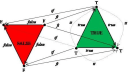
Shouldn’t the one-one correspondence resulting from the universal mapping property definition of SUM:
A + B —> T
A —> T, B —> T
and the corresponding logical avatar OR / disjunction involve OR instead of the AND (Conceptual Mathematics textbook, p. 350); simply put, shouldn’t the (above) comma “,” (below the horizontal line) mean OR instead of AND? What made this question stay with me all these decades is an epic comparable in its reach to the universal form that Krishna’s mother saw when she, worried that the child Krishna might be eating mud, asked him to open his mouth.
Having heard of the difficulties in parameterizing all that is even within limited domain of discourse, it’s all the alibi I need to save (for later ;) doing the exercises involved. For now, I’ll have to content myself with a mere naming of all those extended family members of AND / OR, who kept calling me lest I forget them or fail to adequately acknowledge their propinquity with the aforementioned logical operations.
Primacy of AND: Choosing coffee OR tea is possible only If a menu has both coffee AND tea. Is this why we speak of product (x) and coproduct (+)? Yes and yes, we’ll be doing Exercises 7 and 8 (Conceptual Mathematics, pp. 356 - 357). How are we going to reconcile this primacy of product with our miseducation: multiplication as a shorthand for addition (ibid, p. 238). It gets all the more perplexing when dealing with physical quantities (mass + acceleration is a cardinal sin, while mass x acceleration is puritanical Bostonian ;)
Product is the first step to sum: In order to add a pair of numbers, it can’t be that shocking that we have to first pick the pair: 1 —<n, n’>—> N x N (Conceptual Mathematics, p. 302).
Algebraic categories: An object of an algebraic category is a set A, along with a binary operation (#) i.e., (A, #), and morphisms f: (A, #) —> (A’, #’) between objects are respectful of operations, i.e., f (a # b) = f (a) #’ f (b). Of course, we’ll be doing the exercise involving exponentiation and Exercise 2, which is about finding an isomorphism between addition of odd / even numbers and multiplication of positive / negative numbers (Conceptual Mathematics, pp. 65 - 66).
Binaries in the age of families: Am I the only one who has trouble seeing the added value, if any, of binary operations, not to mention having to carry the weighing down associativity baggage, especially when products and coproducts are defined for families of objects (Conceptual Mathematics, pp. 220 - 283)?
Exponentiation: Unlike multiplication and addition, exponentiation is intrinsically about not only pairs of objects but, more specifically, ordered pairs, in that a map object is the totality of maps from a domain object to a codomain object; however there’s variable exponentiation, which might throw a wrench into my sketch to beam up exponentiation, way high, beyond akasha ;) Be that as it may, there’s no denying the nontriviality of exponentiation axiom in topos theory (and then there are cartesian closed categories; Conceptual Mathematics, pp. 311 - ). Of course, I’m not like one of those mental scientists in the USA, who think they discovered the mind-matter problem, just to name one, and use all available stones so that the rest of the scientific community (or what’s left of it ;) thinks exactly as they do (p.s. when the teacher of Rama told him that it’s all just a dream of Vishnu, the child Rama, quite naturally asked: how do mental dreams become material reality?); so, I see that in elevating exponentiation, unlike product / sum that are mere universal mapping properties, to higher universal mapping property status, those in the know knew.
I’ll be back soon to build a temple for EXPONENTIATION (befitting its architecture / good for ;)
I am truly grateful to Madam Fatima Lawvere /\ /\ /\
—————————————————————————————
Ejercicio 2 (Matemáticas Conceptuales, p. 65)
—
3 + 5 = 8
7 + 9 = 16
13 + 15 = 28
—
3 + 4 = 7
5 + 8 = 13
7 + 10 = 17
—
4 + 5 = 9
6 + 7 = 13
8 + 9 = 17
—
4 + 6 = 10
6 + 8 = 12
8 + 10 = 18
—
Numbers = {… 2, 3, 4 …}
Odd numbers = {… 3, 5, 7 …}
Even numbers = {… 2, 4, 6 …}
—
Odd + Odd = Odd
—
Odd + Even = Odd
—
Even + Odd = Odd
—
Even + Even = Even
__
-2 x (-3) = 6
-3 x (-4) = 12
-4 x (-5) = 20
—
-2 x 3 = -6
-3 x 4 = -12
-4 x 5 = -20
—
2 x (-3) = -6
3 x (-4) = -12
4 x (-5) = -20
—
2 x 3 = 6
3 x 4 = 12
4 x 5 = 20
—
Numbers = {… -3, -2, -1, 0, 1, 2, 3 …}
Negative numbers = {… -3, -2, -1 …}
Positive numbers = {… 1, 2, 3 …}
—
Negative number x Negative number = Positive number
Negative number x Positive number = Negative number
Positive number x Negative number = Negative number
Positive number x Positive number = Positive number
—
An Algebraic Category
Objects: (set of elements, combination rule); O = (A, #), O’ = (A’, #’), ….
D = ({odd, even}, +)
S = ({negative, positive}, x)
Morphisms (between objects): f: O —> O’ are functions f: A —> A’ respectful of combination rules, i.e., for any pair of elements a, b in the domain set O, the function f: O —> O’, in order to be a morphism of our algebraic category, must satisfy:
f (a # b) = f (a) #’ f (b)
Are there any morphisms between the two objects of our algebraic category?
Since every morphism is a function, let’s see if there are any functions between the sets of our two objects (D and S). The two sets of the two objects are:
D = {odd, even}
S = {neg, pos}
First, let’s enumerate all possible functions between the above two sets:
There are 4 functions from D to D.
(i) d1: D —> D, with d1 (odd) = odd and d1 (even) = odd
(ii) d2: D —> D, with d2 (odd) = even and d2 (even) = odd
(iii) d3: D —> D, with d3 (odd) = odd and d3 (even) = even
(iv) d4: D —> D, with d4 (odd) = even and d4 (even) = even
Now let’s see if any of the above four functions is a morphism:
f: ({odd, even}, +) —> ({odd, even}, +)
i.e., satisfying
f (a + b) = f (a) + f (b)
where a, b are generic reference to all pairings of elements of the set:
D = {odd, even}
Let’s start with the function:
(i) d1: D —> D, with d1 (odd) = odd and d1 (even) = odd
which, in order to be a morphism, has to respect the combination rule, i.e., satisfy:
d1 (a + b) = d1 (a) + d1 (b)
With a = odd, b = odd:
d1 (odd + odd) = d1 (odd) + d1 (odd)
d1 (even) = odd + odd
we find that:
odd = even
i.e., the function d1 is not a morphism of our algebraic category.
Continue to the next function:
d3: D —> D, with d3 (odd) = odd and d3 (even) = even
which, in order to be a morphism, has to respect the combination rule, i.e., satisfy:
d3 (a + b) = d3 (a) + d3 (b)
With a = odd, b = odd:
d3 (odd + odd) = d3 (odd) + d3 (odd)
d3 (even) = odd + odd
we find that:
even = even
Next, we have to check d3 at a = odd, b = even:
d3 (odd + even) = d3 (odd) + d3 (even)
d3 (odd) = odd + even
odd = odd + even
we find that:
odd = odd
Lastly, we have to check d3 at a = even, b = even:
d3 (even + even) = d3 (even) + d3 (even)
d3 (even) = even + even
even = even + even
we find that:
even = even
Next, we have to check d3 at a = odd, b = even:
d3 (odd + even) = d3 (odd) + d3 (even)
d3 (odd) = odd + even
odd = odd + even
we find that:
odd = odd
Next, we have to check d3 at a = even, b = odd:
d3 (even + odd) = d3 (even) + d3 (odd)
d3 (odd) = even + odd
odd = even + odd
we find that:
odd = odd
Thus, the function:
d3: D —> D, with d3 (odd) = odd and d3 (even) = even
in respecting the combination rule (+), i.e., having satisfied:
d3 (a + b) = d3 (a) + d3 (b)
at all four points:
(odd, odd), (odd, even), (even, odd), and (even, even)
is a morphism:
d3: ({odd, even}, +) —> ({odd, even}, +)
of our algebraic category. The above d3 is not just any run of the mill morphism; it’s the identity morphism on the object
D = ({odd, even}, +)
of our algebraic category, but for which we would be sent to gallows for acting all along as if we have a category. However, it shouldn’t shock-awe since the function:
d3: D —> D
with d3 (odd) = odd and d3 (even) = even, is the identity function on the set:
D = {odd, even}.
… body break time … sometimes i wonder if only i were a mind, i’d have done all that i have been thinking of doing … thoughts, unlike things, don’t weigh; it’s a categorical mistake to speak of, say, pounds of thought, even if you subscribe to the basic tenet of Anglo-American colonial epistemology:
Truth is what I can get away with.
which is a little less evil than the so-called religion of peace:
Stoning to death for questioning.
.
.
.
There are 4 functions from D to S.
There are 4 functions from S to D.
There are 4 functions from S to S.
—
P.S. As much as I am not into spices (yes and yes I’m an Indian, born in Andhra, living in Bengaluru (more than anyone would want to know about me ;) and yet I’m not a big fan of spicy curries; I’d rather happily eat plain steamed white rice (stimulation is not my thing), I am going to spice up the all too familiar odd vs. even into a not so familiar: Unity and Identity of Adjoint Opposites (for it is a time-tested method of getting to know unknowns in terms of knowns; https://lawverearchives.com/wp-content/uploads/2025/10/Bill_s_messages_to_the_categories_list-5.pdf p. 36).
—
As is my wont, I can’t help but go off on a tangent (if I were to give a positive spin: there used to be this thing called Sadhavadhanam, which is a somewhat elitist celebrations of divided attention. Being an non-elitist that I’m (in my mind ;) if you ever happen to be in Boston, you can see the universality of it all at Wally’s Café (you’ll get a discount for saying my name ;)
The above discussed:
Odd + Odd = Odd
Odd + Even = Odd
Even + Odd = Odd
Even + Even = Even
—
reminded me of:
—
false AND false = false
false AND true = false
true AND false = false
true AND true = true
—
I can hear you loud and clear:
Even if I give a pass for the rabbit you pulled out of your hat, i.e.,
odd : even : : false : true
there’s no way you can get away with:
+ = AND
when in fact:
+ = OR
I know! But I also know that in linear categories:
A + B = A x B (p. 17)
which, includes, plausibly even more unpalatable:
—
Exercise 2 (Conceptual Mathematics, p. 66)
Find an isomorphism
({odd, even}, +) — f —> ({pos, neg}, x)
To begin with an isomorphism is a morphism is a function (aping Gertrude Stein ;)
So, let’s begin with functions:
f: {odd, even} —> {pos, neg}
There are four functions:
f1 (odd) = pos and f1 (even) = pos
f2 (odd) = neg and f2 (even) = pos
f3 (odd) = pos and f3 (even) = neg
f4 (odd) = neg and f4 (even) = neg
You probably remember the drill: Check if the above functions are morphisms, i.e., see if any of the above functions are structure-respecting, i.e., satisfy:
f (a + b) = f (a) x f (b)
What’s there to wait for? Let’s start:
f1 (odd) = pos and f1 (even) = pos
Evaluating f1 at (odd, odd):
f1 (odd + odd) = f1 (odd) x f1 (odd)
f1 (even) = pos x pos
pos = pos x pos
pos = pos
Evaluating f1 at (odd, even):
f1 (odd + even) = f1 (odd) x f1 (even)
f1 (odd) = pos x pos
pos = pos x pos
pos = pos
Evaluating f1 at (even, odd):
f1 (even + odd) = f1 (even) x f1 (odd)
f1 (odd) = pos x pos
pos = pos x pos
pos = pos
Evaluating f1 at (even, even):
f1 (even + even) = f1 (even) x f1 (even)
f1 (even) = pos x pos
pos = pos x pos
pos = pos
So, the function:
f1: {odd, even} —> {neg, pos}
f1 (odd) = pos and f1 (even) = pos
is a morphism:
f1: ({odd, even}, +) —> ({pos, neg}, x)
—
Now we have to check to see if the morphism f1 is an isomorphism, i.e., see if there is a morphism:
g: ({pos, neg}, x) —> ({odd, even}, +)
whose composites with:
f1: ({odd, even}, +) —> ({pos, neg}, x)
both of which are identities, i.e.,
g o f1 = identity ({odd, even}, +)
I don’t know if you remember, but if you scroll up, you’ll find that we have already worked out:
identity ({odd, even}, +) = ({odd, even}, +) — d3 —> ({odd, even}, +)
We also need to show that:
f1 o g = identity ({pos, neg}, x)
—
Maybe I’m little tired to go through case by case or little eager to wind up the tale for today, I looked at the:
Hint: There are only two invertible maps of sets from {odd, even} to {pos, neg}. One of them ‘respects the combining rules’, but the other doesn’t (Conceptual Mathematics, p. 66).
Thanks to the hint, since f1 is neither one-one nor onto, it’s chance of being an isomorphism is zilch. In a less depressing tone, the two functions:
f2 (odd) = neg and f2 (even) = pos
and
f3 (odd) = pos and f3 (even) = neg
have a chance of being isomorphisms. But first let’s find which one of the above two functions is a morphism, i.e., respects the combining rules:
f (a + b) = f (a) x f (b)
Yes, and yes; everyday is a groundhog day ;)
Let’s start:
f2 (odd) = neg and f2 (even) = pos
Evaluating f2 at (odd, odd):
f2 (odd + odd) = f2 (odd) x f2 (odd)
f2 (even) = neg x neg
pos = pos
pos = pos
Evaluating f2 at (odd, even):
f2 (odd + even) = f2 (odd) x f2 (even)
f2 (odd) = neg x pos
neg = neg
Evaluating f2 at (even, odd):
f2 (even + odd) = f2 (even) x f2 (odd)
f2 (odd) = pos x neg
neg = neg
Evaluating f2 at (even, even):
f2 (even + even) = f2 (even) x f2 (even)
f2 (even) = pos x pos
pos = pos
So, the function:
f2: {odd, even} —> {neg, pos}
with:
f2 (odd) = neg and f2 (even) = pos
is a morphism:
f2: ({odd, even}, +) —> ({pos, neg}, x)
—
Now we have to check to see if the morphism f2 is an isomorphism, i.e., see if there is a morphism:
g: ({pos, neg}, x) —> ({odd, even}, +)
whose composites with:
f2: ({odd, even}, +) —> ({pos, neg}, x)
both of which are identities, i.e.,
g o f2 = identity ({odd, even}, +)
I don’t know if you remember, but if you scroll up, you’ll find that we have already worked out:
identity ({odd, even}, +) = ({odd, even}, +) — d3 —> ({odd, even}, +)
We also need to show that:
f2 o g = identity ({pos, neg}, x)
—
Now that it is a lazy day, I'm guess:
g2: ({pos, neg}, x) —> ({odd, even}, +)
with:
g2 (pos) = even and g2 (neg) = odd
is the inverse of:
f2 (odd) = neg and f2 (even) = pos
First, we have to make sure the function:
g2: {pos, neg} —> {odd, even}
is a morphism, i.e., satisfies:
g2 (a x b) = g2 (a) + g2 (b)
You know the drill:
Evaluating g2 at (pos, pos):
g2 (pos x pos) = g2 (pos) + g2 (pos)
g2 (pos) = even + even
even = even
Evaluating g2 at (pos, neg):
g2 (pos x neg) = g2 (pos) + g2 (neg)
g2 (neg) = even + odd
odd = odd
Evaluating g2 at (neg, pos):
g2 (neg x pos) = g2 (neg) + g2 (pos)
g2 (neg) = odd + even
odd = odd
Evaluating g2 at (neg, neg):
g2 (neg x neg) = g2 (neg) + g2 (neg)
g2 (pos) = odd + odd
even = even
So far so good, which is say that our function:
g2: {pos, neg} —> {odd, even}
with:
g2 (pos) = even and g2 (neg) = odd
is indeed a morphism:
g2: ({pos, neg}, x) —> ({odd, even}, +)
Next, more of the same drill (till you drown ;)
Now we have to check to see if the morphism:
f2: ({odd, even}, +) —> ({pos, neg}, x)
is an isomorphism, i.e., see if both composites with the morphism:
g2: ({pos, neg}, x) —> ({odd, even}, +)
are identities, i.e.,
g2 o f2 = identity ({odd, even}, +)
and
f2 o g2 = identity ({pos, neg}, x)
I don’t know if you remember, but if you scroll up, you’ll find that we have already worked out:
identity ({odd, even}, +) = d3: ({odd, even}, +) —> ({odd, even}, +)
Let’s check to see if:
g2 o f2 = identity ({odd, even}, +)
Now I remember not showing that the composite of a composable pair of morphisms in our algebraic category is also a morphism of the algebraic category.
Just to be clear, we have a morphism:
f2: ({odd, even}, +) —> ({pos, neg}, x)
that is a function:
f2: {odd, even} —> {neg, pos}
with:
f2 (odd) = neg and f2 (even) = pos
satisfying:
f2 (odd + odd) = f2 (odd) x f2 (odd)
f2 (odd + even) = f2 (odd) x f2 (even)
f2 (even + odd) = f2 (even) x f2 (odd)
f2 (even + even) = f2 (even) x f2 (even)
along with a morphism:
g2: ({pos, neg}, x) —> ({odd, even}, +)
that is a function:
g2: {pos, neg} —> {odd, even}
with:
g2 (pos) = even and g2 (neg) = odd
satisfying:
g2 (pos x pos) = g2 (pos) + g2 (pos)
g2 (pos x neg) = g2 (pos) + g2 (neg)
g2 (neg x pos) = g2 (neg) + g2 (pos)
g2 (neg x neg) = g2 (neg) + g2 (neg)
Now we have to show that:
g2 o f2 = identity ({odd, even}, +)
First we have to evaluate the composite morphism:
g2 o f2: {odd, even} —> {pos, neg} o {pos, neg} —> {odd, even}
g2 o f2: {odd, even} —> {odd, even}
based on:
f2 (odd) = neg and f2 (even) = pos
and:
g2 (pos) = even and g2 (neg) = odd
g2 o f2 (odd) = g2 (neg) = odd
g2 o f2 (even) = g2 (pos) = even
So, the we have:
g2 o f2 = identity {odd, even}
Now we have to show that the composite identity function:
g2 o f2: {odd, even} —> {odd, even}
satisfies:
g2 o f2 (a + b) = (g2 o f2) (a) + (g2 o f2) (b)
Evaluating the composite g2 o f2 at (odd, odd):
g2 o f2 (odd + odd) = g2 o f2 (odd) + g2 o f2 (odd)
g2 o f2 (even) = g2 (neg) + g2 (neg)
g2 (pos) = odd + odd
even = even
Evaluating the composite g2 o f2 at (odd, even):
g2 o f2 (odd + even) = g2 o f2 (odd) + g2 o f2 (even)
g2 o f2 (odd) = g2 (neg) + g2 (pos)
g2 (neg) = odd + even
odd = odd
Evaluating the composite g2 o f2 at (even, odd):
g2 o f2 (even + odd) = g2 o f2 (even) + g2 o f2 (odd)
g2 o f2 (odd) = g2 (pos) + g2 (neg)
g2 (neg) = even + odd
odd = odd
Evaluating the composite g2 o f2 at (even, even):
g2 o f2 (even + even) = g2 o f2 (even) + g2 o f2 (even)
g2 o f2 (even) = g2 (pos) + g2 (pos)
g2 (pos) = even + even
even = even
Finally, we have showed that the composite function:
g2 o f2 = {odd, even} —> {odd, even}
is the identity morphism:
identityD: {odd, even} —> {odd, even}
Along these lines, we can show that the composite function:
f2 o g2 = {pos, neg} —> {pos, neg}
is the identity morphism:
identityS: {pos, neg} —> {pos, neg}
which is all we need to conclude that:
f2: ({odd, even}, +) —> ({pos, neg}, x)
is an isomorphism, with the morphism:
g2: ({pos, neg}, x) —> ({odd, even}, +)
as its two-sided inverse.
… again it’s that time that i need to eat / drink / inhale / sleep / bodybiz … back as soon as my mind says enough is enough to my body ;)
—
AI Pop-quiz:
I guess I am not all alone in seeing the logical operation XOR in the above:
Negative number x Negative number = Positive number
Negative number x Positive number = Negative number
Positive number x Negative number = Negative number
Positive number x Positive number = Positive number
It’s this XOR that Minsky deployed, a’la COVID that evil Gates unleashed, freezing research on the mind, and mindless killing of unsuspecting people, respectively.
P.S. The evil that is Bill Gates is still alive eating babies; hey Ram, what’s this?
P.P.S. I still can’t figure out how those Londoners (and their ilk), with their king under their very noses or in one of their orifices, can scream: NO KINGS, while their dear mayor—some stoopid khan—in an Oscar performance, acts, knowing full-well, unawares of his islamic grooming gangs, and their heinous crimes against helpless children, as though it’s all Greek and Latin … what a wonderful world!!!
—
The isomorphism between ({odd, even}, +) and ({pos, neg}, x) means that addition of odd / even numbers has the same form as that of multiplying positive / negative numbers. In all sincerity I don’t know what to make of this “same form”, but it sounded like me and you have same amount of money, which is telling, but wouldn’t be more telling if what exactly that “same amount” of money amounts to? In the case of you and me having the same amount of money, characterization of which as “remarkable” seems unremarkable going by statistics. But what exactly is the mathematics / algebra that makes the fact that the same form of both addition of odd / even numbers and multiplication of positive / negative numbers remarkable?
As if this ain’t spicy enough, the above isomorphism is an analog of, yes of course, the remarkable “same form” of both the addition of real numbers and multiplication of positive numbers, where the analog being the isomorphism:
exp: (R, +) —> (R>0, x)
Exponentiation:
exp^x = e^x
Note that exponentiation satisfies the requirement to be a map of an algebraic category, i.e.,
f (a # b) = f (a) #’ f (b)
we now show that exp / e satisfies the required condition to be a map of the algebraic category, i.e.,
e^(a + b) = e^a x e^b
Next, we have the inverse of exponentiation, i.e., the natural logarithm:
ln: (R>0, x) —> (R, +)
Given that we don’t have whole lot going in our lives, we might as well show that the natural logarithm / ln is a map in our algebraic category, which means satisfying:
g (c #’ d) = g (c) # g (d)
specializing to ln:
ln (c x d) = ln (c) + ln (d)
Now that we have both:
exp: (R, +) —> (R>0, x)
defined as: e^(a + b) = e^a x e^b
and
ln: (R>0, x) —> (R, +)
defined as: ln (c x d) = ln (c) + ln (d)
we now have to show that they are isomorphisms (two-sided inverses):
ln o exp: (R, +) — exp —> (R>0, x) o (R>0, x) — ln —> (R, +) =
(R, +) —> (R, +) = identity (R, +)
and
exp o ln: (R>0, x) — ln —> (R, +) o (R, +) — exp —> (R>0, x) =
(R>0, x) —> (R>0, x) = identity (R>0, x)
Let’s start (if you’re new to my neck of the woods, there’ll be many starts / beginnings ;) with:
ln o exp: (R, +) — exp —> (R>0, x) — ln —> (R, +)
With a generic pair of real numbers (r, s), we have:
ln o exp (r, s) = ln (e^(r + s)) = ln (e^r x e^s) = ln (e^r) + ln (e^s) = r +s
which is to say the composite:
ln o exp: (R, +) —> (R, +)
maps (r + s) to (r + s), thus we have one of the two identities required of an isomorphism:
ln o exp: identity (R, +)
Next, we evaluate the composite:
exp o ln: (R>0, x) — ln —> (R, +) — exp —> (R>0, x)
With a generic pair of positive numbers (p, q)
exp o ln (p, q) = exp (ln (p x q)) = exp (ln (p) + ln (q)) = exp^ln (p) x exp^ln (q) = p x q (provided p, q are positive, which is what we are given: (R>0, x)), which is to say that the composite:
exp o ln: (R>0, x) —> (R>0, x)
maps (p x q) to (p x q), thus we have the second identity:
exp o ln: identity (R>0, x)
Finally we have two isomorphisms, with no idea of what that “same form” might be (please feel free to pitch in your fav peccadillo / picadillo ;)
Lests you thinking we are getting to the END card (nothing ends in my scheme of things; it’s cycling (by the way, not that I’m proud of it, but don’t think I really understand how exactly going in circles moves you ahead, while I seem to understand how walking moves me forward, which is why I prefer to walk :)
Upcoming attraction:
If young, then happy.
In terms of the familiar implication symbol: young => happy. Switching gears from logic to geometry, we get to exponentiation, in terms of which: happy^young.
If rich, then happy.
‘If young, then happy’ AND ‘If rich, then happy’
happy^young x happy^rich = happy^(young + rich)
If (young OR rich), then happy.
Then there’s the dreaded minus:
happy but not rich (cf. Sets for Mathematics, p. 201).
Then there are products of categories (presheaf categories; e.g., dynamical systems, functions, directed graphs, reflexive graphs ranging the entire spectrum of localic, combinatorial, and geometric) and given that the category of categories is cartesian closed, I wonder how significant is the familiar exponentiation:
S^T x S^T’ = S^(T + T’)
albeit now exponents are not mere numbers or predicates but theories objectified as geometric structures, while the base is the discrete subcategory into which the theories are interpreted (Functorial Semantics of Theories, p. 12; see also Axiomatization and Education, pp. 215, 217-219).
Given my inability to let go off questions, I can’t help but bring everything that’s remotely (lightyears apart ;) related to inform my struggle (of the day :) “same form”
Given that even and odd numbers can be construed as left and right adjoints of an instance of Unity and Identity of Adjoint Opposites, (https://lawverearchives.com/wp-content/uploads/2025/10/Bill_s_messages_to_the_categories_list-5.pdf, p. 36), does addition / sum / coproduct / colimit of [inclusion] functors help in spelling out the form, beyond that it is an extensive quality. Then again, this form must be the same as that of multiplication of positive and negative numbers (with positive numbers as an abstraction of sets; the only isomorphism invariant external property of sets, p. 1). Now would it be too much to ask, thanks to freedom that’s ignorance, if negative numbers are to negative sets, what sets are to positive numbers 0, 1, 2 …. Then there is the multiplication / product / limit of positive and negative sets. Now that it all sounds like talking in tongues, I’ll leave you with what might—might—have a chance of being an iota of sensible:
Can’t the “same form”, that’s haunting us / me ;) spelled out in terms of, say, groups, involutions, and monoids?
—
I’ll be back to the restaurant soon (Ejercicio 7 y 8, pp. 352 -353). I’m sure they have veg options; it’s just that I have recently gone vegetarian. One good thing about India is that it’ll take me all of my lifetime to go through all the veggies that are :)
Madam Fatima Lawvere
https://categories.org.au/archives/list/categories-list@categories.org.au/thread/XEZGELTGKG7IT5XH43POHHY72533KEPY/
I felt Madam Fatima Lawvere and Professor F. William Lawvere might enjoy watching our Che Guevara attract butterflies :)
https://www.youtube.com/shorts/unNwwTu6hJg